
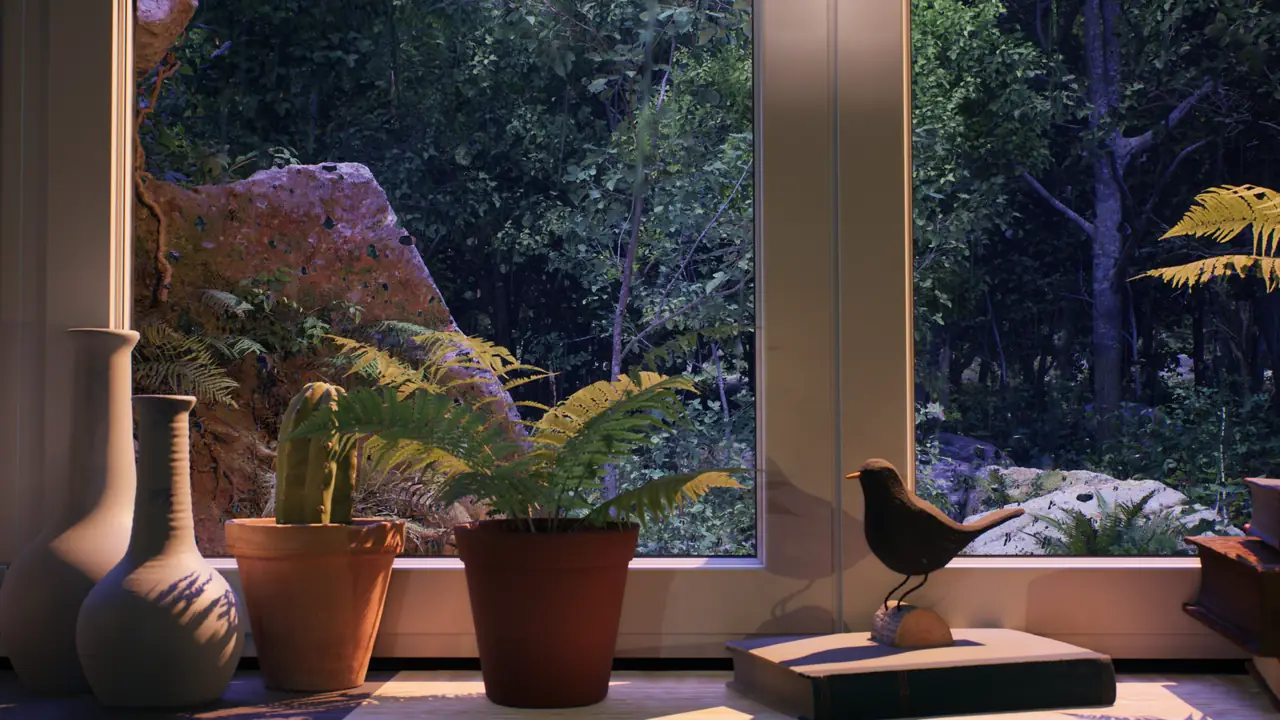
Each Window Ambience Studio video is designed to behave less like a piece of entertainment and more like a believable view that can live quietly inside a room. That changes the way each scene is built. The goal is not just to produce a beautiful still image, but to create a stable environment whose light, weather, depth and sound can remain convincing for a long stretch of time on a TV, monitor or projector wall.
This process is deliberate and handcrafted from beginning to end. Scenes are not assembled from stock footage or generated as AI video. They are planned, blocked out, lit, animated and rendered as original 3D environments, then shaped further through editing and sound design so the final result feels calm, coherent and usable in everyday interiors.
1. Starting from a room mood, not just a visual idea
The first question is usually not “what looks impressive?” but “what should this screen feel like in a real room?” A rainy city at night, a candlelit apartment, a quiet forest or a snowy window all create different relationships with the viewer. Some scenes are better for winding down in a bedroom, others for a reading corner, a projector wall, a waiting area or a calm living room background.
That means the early stage is part creative exploration, part location research. The scene needs a believable sense of place, a clear foreground and a stable point of view. Window frame, ledge, curtains, nearby objects, horizon line and weather direction all matter because they decide whether the image reads as a world beyond the glass or just as a decorative animation.
This is also where pacing is decided. A Window Ambience Studio scene is built for long-form playback, so the composition has to survive repeated viewing. The image needs enough life to stay present, but not so much movement that it keeps pulling attention back to the screen.
2. Building the environment in 3D
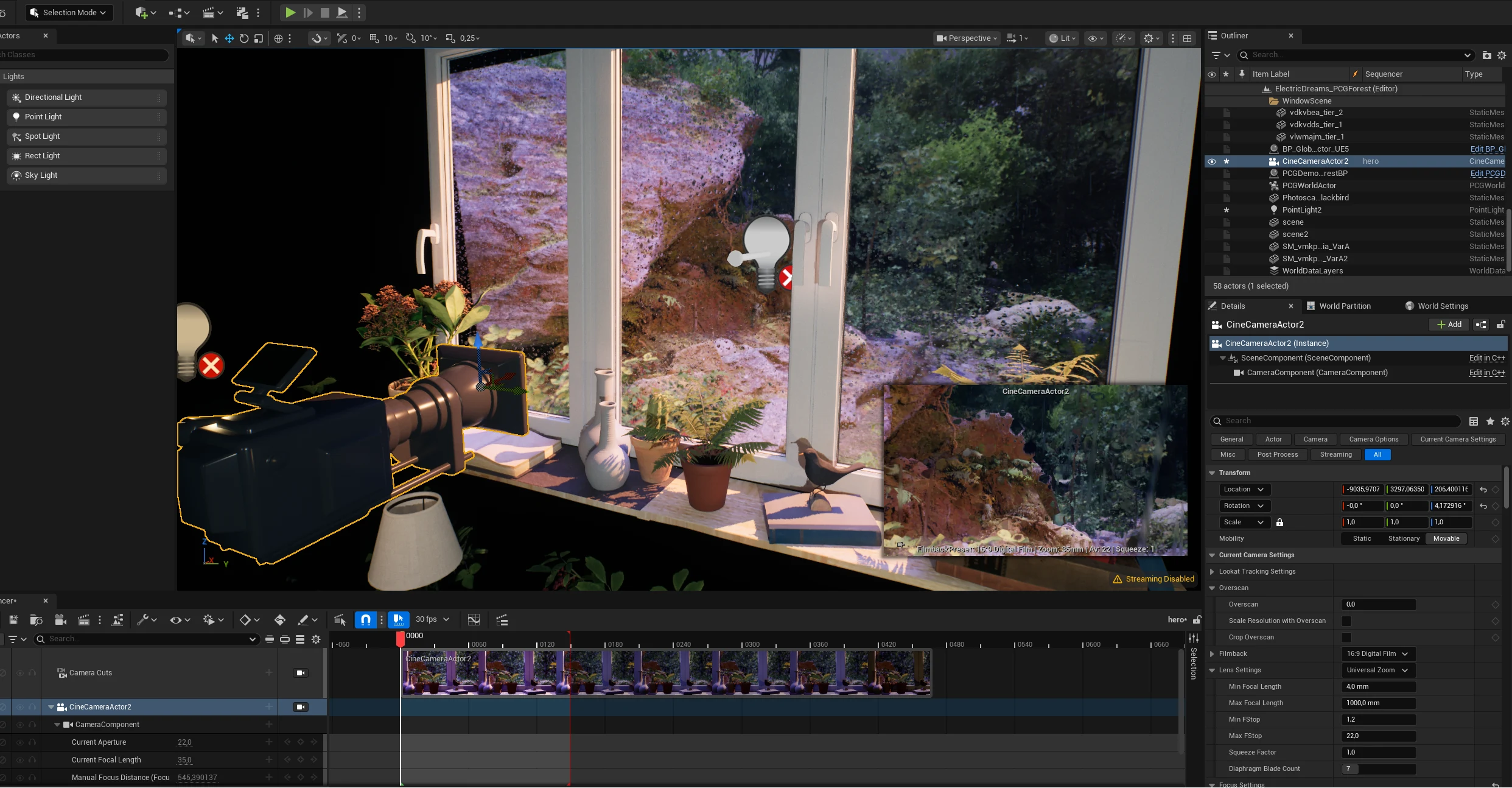
Once the idea is clear, the scene is built as an original 3D environment. Architecture, furniture, glass, weather surfaces, vegetation, distant buildings and room details are assembled so the frame has depth at every layer. The view outside the window matters, but so does the interior edge of the scene, because the illusion often depends on that boundary between inside and outside.
The camera usually stays fixed. That decision is simple, but it defines the whole discipline of the scene. Because the camera is not wandering through the world, more attention goes into micro-movement: rainfall, shifting cloud light, distant traffic glow, leaves moving in the wind, snow drifting across depth, water movement or subtle candle flicker. The stillness of the frame is what lets the screen feel architectural rather than cinematic in the usual sense.
Unreal Engine is useful here because it gives precise control over light, weather, materials and atmosphere. It is not used as a technical showcase for its own sake. The point is that a quiet scene still needs control. Reflections on glass, softness in shadow, the density of rain, haze in the distance and the balance between interior warmth and exterior cool light all need to be tuned carefully if the result is supposed to feel real enough to live beside.
3. Lighting, atmosphere and motion
Lighting is one of the biggest differences between an ambience scene and an ordinary decorative loop. A room-view composition works because the image already suggests how the light exists in space: moonlight on wet stone, cool sky beyond glass, soft warm pools near candles, distant sodium or city light, dim reflections on a floor, muted cloud cover in the background. If those relationships are off, the scene may still look striking, but it stops feeling believable.
Atmosphere is treated the same way. Rain, fog, snow, dust, vapor and depth haze are not there only to make the image busy. They help scale the space and slow the scene down. A distant skyline feels farther away when weather passes between the viewer and the background. A forest feels more enclosed when the air has density. These details help a flat display behave more like a window into a space.
Movement is then kept deliberately restrained. Window ambience works best when the scene remains readable in peripheral vision. That is why the motion tends to stay cyclical, soft and layered rather than dramatic: repeated rainfall, subtle branch movement, distant flicker, slow-moving clouds, gentle ripples or quiet snowfall.
If you want to see how these finished scenes are used on screens, the video library and the best fake window videos guide show how different atmospheres behave in bedrooms, living rooms and projector setups.
4. Rendering and final assembly
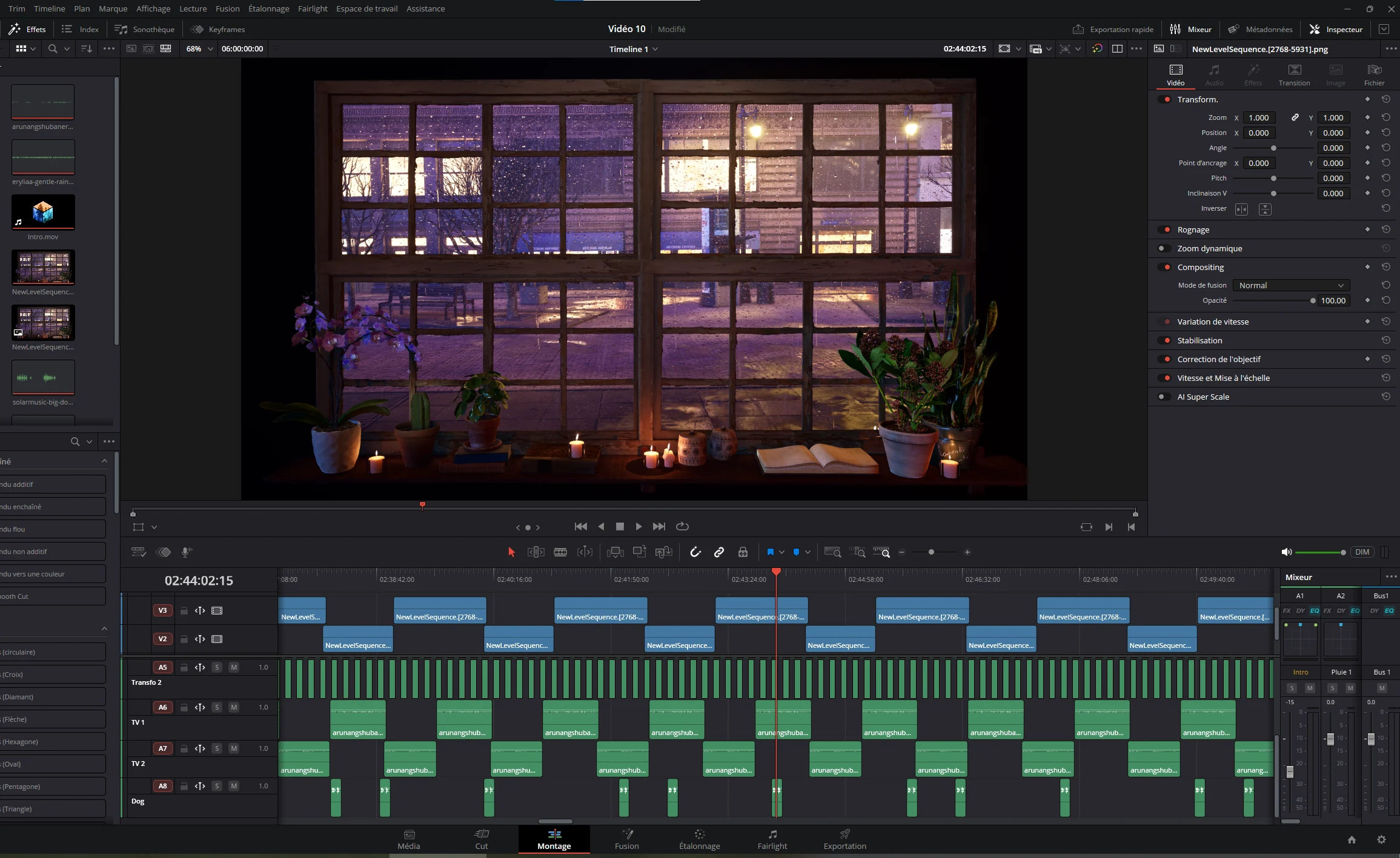
After the environment, light and movement are in place, the scene moves into rendering and final assembly. The long-form goal still matters here. A scene that looks good in a short preview can become tiring over an hour if highlights pulse too hard, if contrast is too aggressive or if movement loops too obviously. Rendering choices therefore support continuity as much as visual quality.
The final edit is less about cutting rapidly and more about preserving a calm visual rhythm. If a scene includes a variation, it still needs to feel stable enough to leave running in the background. The finished video should support slow activities such as reading, resting, conversation, working or preparing for sleep rather than demanding to be watched as an event.
5. Sound design as part of the illusion
Sound is not treated as an afterthought. Rain on glass, room tone, distant traffic, soft thunder, water, birds or interior ambience can all help define the size and feel of the space. Good sound design does not fill every second. It reinforces the same calm logic as the picture: enough presence to support the illusion, but not so much activity that the room starts behaving like a soundtrack-driven experience.
This is one reason the visual process and the audio process stay connected. A soft forest with filtered daylight will call for a different sound texture than a winter city or a candlelit room. The mix is built to match the scale and distance implied by the frame.
For practical setup advice after the scene is finished, the projection guide covers wall placement, brightness and scale, while the TV rain ambience guide shows how to keep calm motion and low-distraction playback in everyday use.
What this process is trying to protect
The whole creative process is built around one constraint: the scene has to remain easy to live with. That means the work is not only about image quality or technical polish. It is about preserving a believable depth, a stable frame, a quiet lighting structure and a sound layer that stays supportive rather than dominant.
When that balance works, the screen stops behaving like an idle black rectangle or a busy loop. It becomes a quiet extension of the room: a rainy street beyond glass, a slow forest view, a warm city window or a distant winter horizon. That is the underlying purpose of the process from concept to final render.
Mini FAQ
Are Window Ambience Studio videos AI-generated?
No. They are original 3D environments, built, lit, animated, rendered and sound-designed through a handcrafted production workflow.
Why use Unreal Engine for ambience videos?
It provides precise control over lighting, weather, materials, atmosphere and camera framing, which is especially useful when a scene needs to feel believable for long-form playback.
Why keep the camera fixed in most scenes?
A fixed frame helps the display behave more like a window than a moving film shot. It lets depth, weather, light and small motion remain readable without continuously pulling attention back to the screen.
Explore long-form ambience scenes on the Window Ambience Studio channel.
Watch on YouTube →