
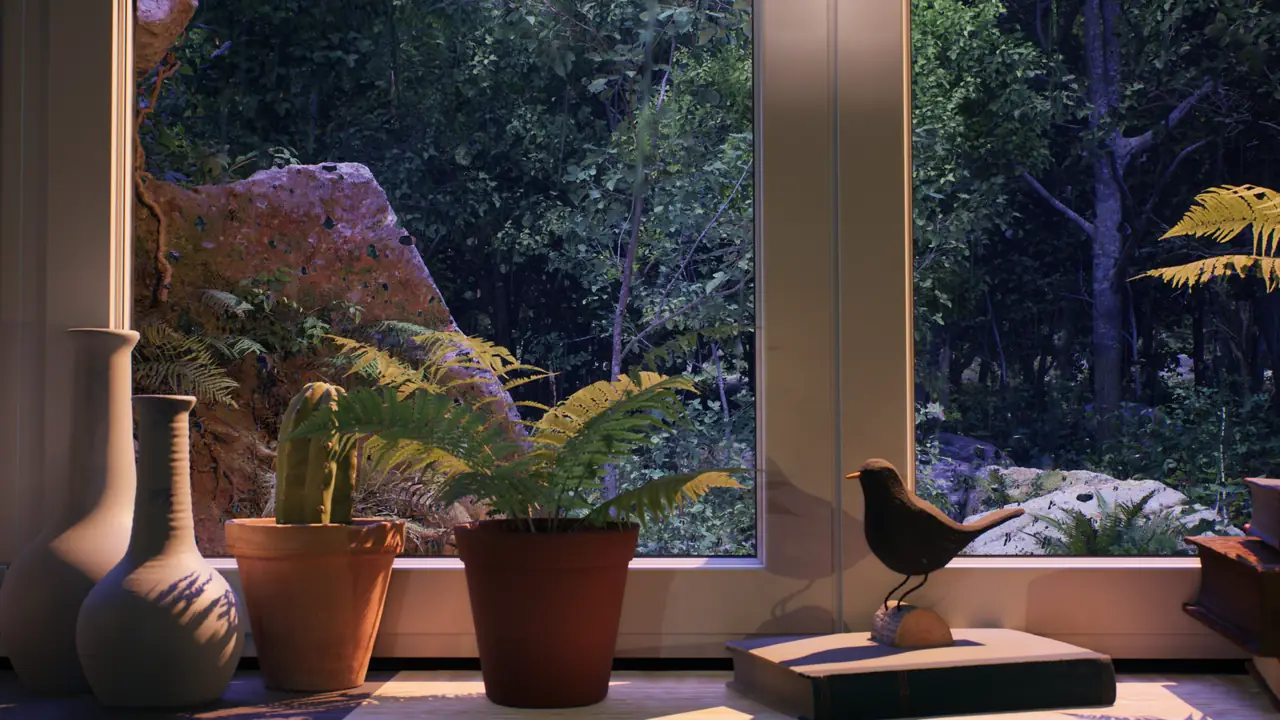
A fake window projector can be especially effective in a small room because it gives one blank wall a sense of depth without adding a large physical object. A studio apartment, compact bedroom or narrow home office may not have space for another screen, a deep media unit or elaborate decor, but it can still support a carefully sized projected view.
The goal is not to make the wall feel like a cinema screen. It is to create a stable, quiet image that feels more like a window than a video you are actively watching. Throw distance, image size, projector position and ambient light matter more in a small room because every cable, shadow and bright surface sits close to the viewer.
This guide focuses on those constraints. It compares projector types without recommending a particular brand, explains how to choose and prepare a wall, shows several space-saving placement options, and suggests Window Ambience Studio scenes whose slow framing remains readable at modest projection sizes.
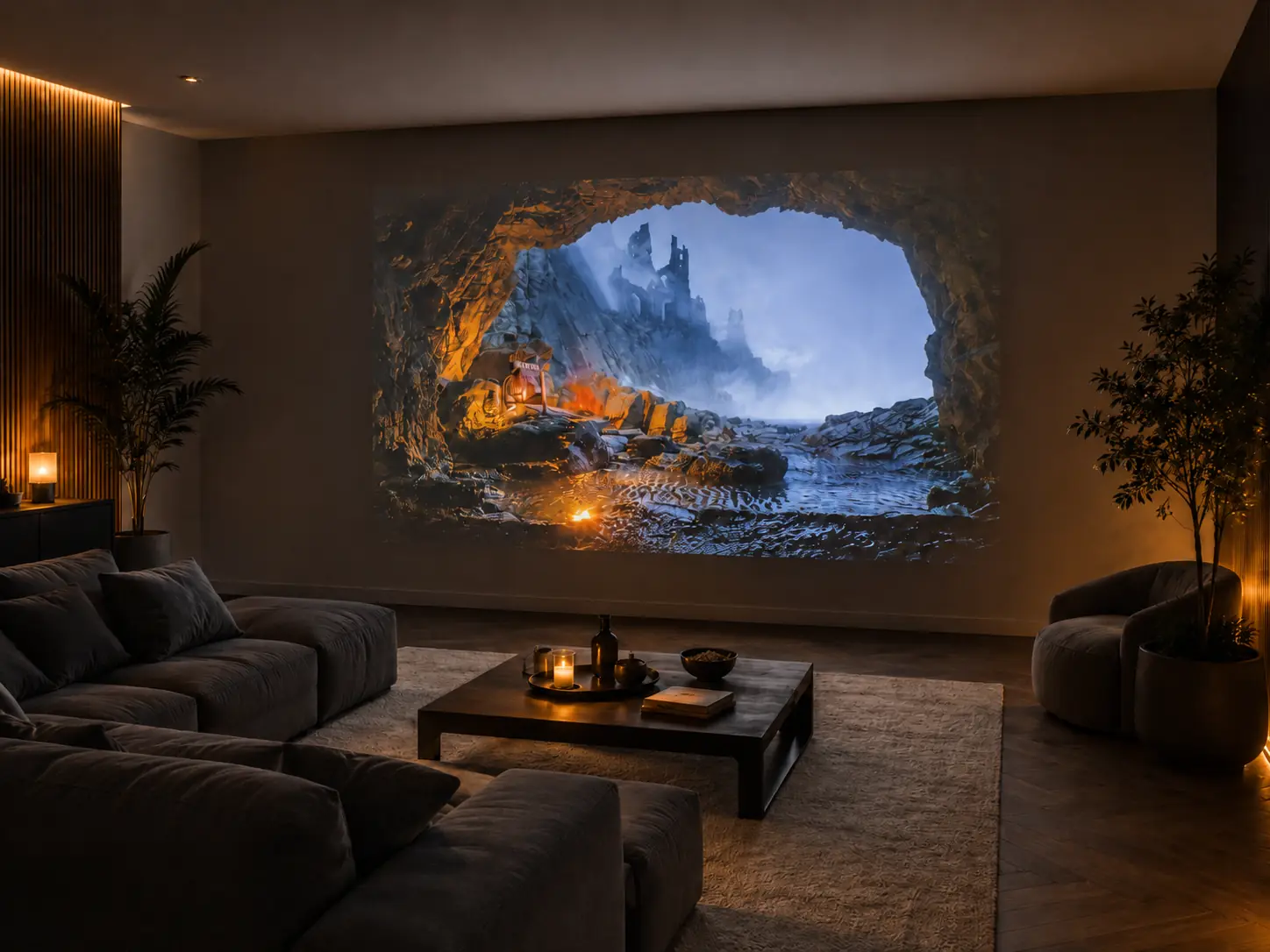
Why small rooms suit a projected fake window
Small rooms often have fewer sightlines and fewer competing focal points. When a calm image appears on the wall opposite a bed, beside a desk or beyond a reading chair, the eye can interpret it as an opening rather than another piece of furniture. The effect does not require a wall-sized picture. A projection roughly comparable to a real apartment window can feel more believable than an image stretched from floor to ceiling.
A compact room also lets the projected view influence the whole atmosphere at moderate brightness. Blue rain, warm candlelight or a forest window can tint nearby surfaces without the projector running at its most aggressive setting. That softer output is useful when the image will remain in the background during reading, quiet work or the last part of the evening.
The limitation is that there is little room to hide a poor setup. A person crossing the beam creates a large shadow. A projector fan may be audible from the bed. A shelf mounted a few centimeters off axis can force heavy digital correction. Treat the room as a complete layout before choosing equipment: mark the viewing position, possible projector positions, wall area and walking routes.
Start with a temporary test. Use a chair or stack of stable boxes to place an existing projector at the likely height, then project a still image or ambience video. Check the result from the bed, chair or desk rather than from beside the machine. This reveals whether the image feels like a view, whether the fan is distracting and whether anyone will interrupt the beam.
Choosing a projector for a short distance
Throw ratio is the useful specification for a small-room fake window. It describes the relationship between the distance from the projector lens to the wall and the width of the image. A lower ratio produces a wider image from less distance. Product pages may use the labels ultra-short throw, short throw and standard throw, but the actual ratio and the manufacturer's distance chart are more reliable than the category name alone.
Ultra-short-throw projectors
An ultra-short-throw projector sits very close to the wall, usually on a low cabinet or dedicated shelf. It keeps the beam away from the center of the room and greatly reduces the chance of someone walking through the picture. This can be valuable in a studio or narrow bedroom where there is no clear path from the opposite wall.
The trade-off is sensitivity. A small movement in the projector can shift the image noticeably, and wall texture or slight waviness may create visible distortion. These projectors also need enough furniture depth and ventilation near the wall. Before buying one, confirm the exact distance required for the modest image width you want; a model designed for a very large television replacement may be awkward when asked to create a smaller window.
Short-throw projectors
A short-throw projector usually works from a shelf, ceiling mount or compact stand placed closer to the wall than a standard model. It offers more flexibility than ultra-short throw while keeping much of the beam out of the main seating area. For many small apartments, this is the practical middle ground: enough distance to adjust the frame, but not so much that the projector must sit behind the viewer.
Check the lens offset as well as the throw ratio. Some models naturally place the image above or below the lens, which may suit a ceiling or shelf installation. Others expect the lens to sit near the center of the picture. Matching that geometry to the room reduces reliance on keystone correction and preserves a cleaner image.
Standard-throw projectors
A standard projector can still work in a small room if it is already available and the desired image is not too wide. It may fit on a high shelf above the bed, on the opposite wall or near the ceiling. The main risks are a beam that crosses the room, visible cables and a throw distance that forces an oversized image. Measure before assuming that zoom will solve the problem.
Whichever type you consider, prioritize a usable throw ratio, quiet operation, enough brightness for your controlled room light, physical lens alignment and convenient input options. Resolution matters, but a well-aligned moderate image on a smooth wall usually feels more convincing than a sharper image distorted by poor placement. The broader fake window projection guide covers the general viewing effect, screens, playback and room integration.
Finding the right wall in a small apartment
Choose the wall from the main viewing position. A fake window normally feels most natural when it occupies a place where an architectural opening could plausibly exist: above low furniture, at the end of a narrow room or on the side wall of a bedroom. Avoid projecting directly behind a desk chair or across the only route to a door, wardrobe or kitchen area.
A matte white or very light neutral surface returns the most predictable color. A pale gray wall can reduce the sense of a glowing rectangle and deepen dark scenes, but it also absorbs light. Strong colors tint the entire video: a beige wall warms snow and blue rain, while a green or pink wall can still make natural scenery look slightly unnatural. Test the actual surface before repainting.
Texture is more noticeable at short viewing distances. Fine paint roller texture may disappear once the video is moving, but rough plaster, brick, wallpaper seams and glossy patches can break straight window frames and highlights. A smooth removable projection panel or tensioned screen can help in a rental, provided it lies flat and does not introduce a heavy cinema-style border.
Keep enough empty wall around the image. A narrow gap beside shelves or posters makes the projection look squeezed into leftover space. If possible, remove one or two competing objects rather than enlarging the projection. A restrained window-sized frame with calm margins often creates more depth than a larger picture touching furniture and corners.
Placing the projector without using floor space
A ceiling mount keeps the projector and cables away from furniture, but it should be treated as a fixed installation. Confirm the lens position with a temporary test before drilling, use fixings appropriate for the ceiling, preserve ventilation, and route power so no loose cable hangs across the room. In a rental, a high wall shelf may be easier to reverse.
A shelf installation works best when the projector can sit level and close to its intended optical axis. Do not place it inside a closed cube or against textiles that trap heat. Leave the clearance specified by the manufacturer and make sure the remote sensor, filter and input ports remain accessible. A small lip or non-slip pad can prevent accidental movement without blocking airflow.
A compact tripod or projector stand is useful when the fake window is occasional. It can move between a bedroom and living area, and it avoids permanent work. Place the legs outside walking routes, secure the power cable along a wall, and choose a stable height that does not tempt constant digital keystone adjustment. Fold the stand away when the room needs its floor space back.
Side projection may look convenient, but extreme angles reduce image quality and make alignment fragile. Use horizontal or vertical lens shift when the projector genuinely provides it. Digital keystone is a fallback, not a substitute for thoughtful placement: it reshapes the image electronically and can reduce usable resolution. A slightly smaller, physically aligned projection is usually the better fake window.
Managing ambient light in a compact space
Ambient light does not need to disappear, but it should be controlled near the projection wall. Direct daylight and a lamp aimed at the image wash out dark rain, forest and night scenes. Blackout curtains offer the strongest control; lined curtains or a dense blind are often enough for evening use. In a studio, separating one bright task lamp from the projection zone can preserve both practical light and atmosphere.
Place lamps to the side of the image or behind the viewing position. A warm floor or table lamp can help the projection belong to the room, especially with candlelit city scenes, but its bulb should not reflect on a glossy wall. If the projected blacks look gray, lower nearby light before increasing projector brightness.
At night, avoid maximum output simply because the projector can provide it. A fake window should remain comfortable in peripheral vision. Use an appropriate picture mode, lower brightness or laser power when available, and retain enough shadow detail to see the window frame and weather. The correct level is the one that remains readable without becoming the brightest object in the room.
Sound also carries differently in a small space. Projector fans, rain audio and speakers are all closer to the listener. Keep ambience volume low and consider moving a small speaker nearer the projected wall so the sound appears to come from the view. If the fan remains intrusive from the bed or desk, a longer cable and a more distant shelf may improve the experience more than a larger image.
Recommended videos for small-room fake windows
Compact projections benefit from simple composition, a stable camera and slow changes. Broad panoramas can lose their scale when reduced to a window-sized image, and scenes with many tiny lights may look busy at close range. Window frames, clear foreground objects and restrained weather help the picture remain legible.
Rainy Forest Window Ambience is a calm choice for a bedroom, desk corner or reading space because its forest view, plants and warm interior details remain coherent at a modest size. Rainy Lake Cabin Window Ambience offers a clearer horizon when the room needs a stronger sense of depth.
Rainy City Window Ambience suits a compact evening setup where candles and urban reflections can connect with warm lamps in the room. For a quieter winter palette, Snowy City Window Ambience gives the wall a soft city view without rapid movement.
Preview a scene at the final image size before committing to it. Check whether its brightest elements pull the eye, whether subtitles or interface overlays appear, and whether the loop can remain in the background. Browse all Window Ambience Studio videos to compare rain, forest, lake, city, snow and fantasy moods. In a small room, the scene that feels calm after twenty minutes is usually a better choice than the one that looks most dramatic in the first ten seconds.
A compact setup checklist
- Measure the wall width, lens-to-wall distance and walking routes before choosing a projector.
- Use the manufacturer's throw chart to confirm the image size instead of relying only on category labels.
- Test the projector temporarily from the real bed, chair or desk position.
- Prefer a smooth matte surface with empty space around a window-sized image.
- Align the projector physically and keep digital keystone correction modest.
- Control light near the wall, keep audio low and preserve projector ventilation.
- Choose a stable long-form scene that remains readable at a compact size.
A successful fake window effect in a small bedroom or apartment is usually built from careful compromises rather than maximum specifications. A moderate image, quiet placement, controlled light and a slow video can make a limited wall feel deeper while leaving the room practical. Set up one element at a time, observe it during normal use, and keep only the adjustments that make the projection easier to live with.
Mini FAQ
Can a fake window projector work in a very small bedroom?
Yes. Measure the wall and throw distance first, keep the image close to a believable window size, and place the projector where the beam does not cross the bed or main walkway. A short-throw or carefully positioned standard projector can work if its distance chart fits the room.
Do I need an ultra-short-throw projector for an apartment?
Not always. Ultra-short throw reduces the open beam, but it needs precise alignment and a flat wall. A short-throw model often offers a useful balance, while a standard projector can work from a high shelf or ceiling if the room provides enough distance.
Can I project a fake window onto a painted wall?
Yes. A smooth matte white or light neutral wall is the most predictable. Pale gray can also work in a light-controlled room. Test the surface first, because heavy texture, gloss and strong paint colors can distort detail or tint the scene.
Explore long-form ambience scenes on the Window Ambience Studio channel.
Watch on YouTube →